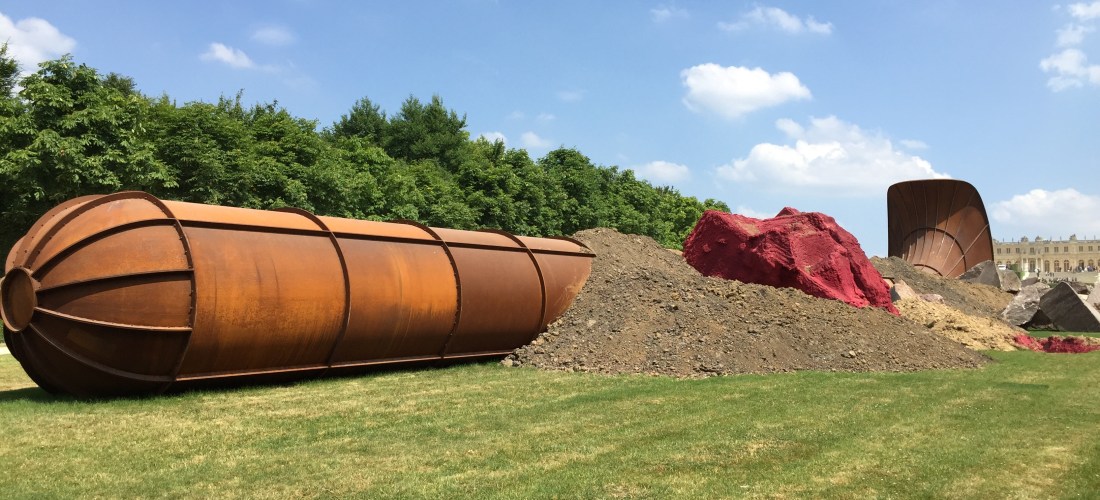
The recent vandalism of Anish Kapoor’s monumental installation at Versailles has become a hot topic in the circle of art people in France. Focus has been diverted to the intention of the behaviors and the political implication. The exhibition has barely been open more than a week before the vandals have left their mark on it. In fact, the victim Dirty Corner, a giant funnel of steel and rock that faces the château, has opened to a swirl of controversy from its very beginning stage of appearance at the château, after the artist has conveyed that the sculpture is meant to resemble “the vagina of the queen coming into power.”
Amongst all the burning debates, my memory rolled back to the week before the vandalism, when I visited the château for the exhibition. I was looking at the work Sectional Body Preparing for Monastic Singularity in the Star Grove when I saw a mediator patiently explained to a couple the details of the works, their significations, the ideas behind, the representations, etc. After nearly 20 minutes’ lesson, the couple left with much thankfulness. “It would have been great if we had seen you right at the start of our visit. We would have already grabbed a better understanding of the works that we had passed through from the very beginning”, they said to the mediator. Perhaps people in the debate of this exhibition had a deep understanding of Anish Kapoor’s works, perhaps not. Above all, it’s time to put the debate aside and start over again to revisit the artist’s works with an eager-learning heart.


One sort of contradiction
The five sculptures placing in the garden, starting from the entrance with C-Curve and Sky Mirror, then Sectional Body Preparing for Monastic Singularity in the Star Grove, Dirty Corner in the centre of the Great Perspective and Descension beyond. The main objective that the artist wants to achieve through his works is to unearth the human condition in all its contradictions.
The first work right when we entered into the château is C-Curve, a mirror running down the sun’s axis. Anyone who has visited the château must have already fascinated by the famous Galerie des Glaces (Hall of Mirrors), in which a total of 357 mirrors are used in decorating the seventeen mirror-clad arches that reflect the seventeen arcaded windows overlooking the gardens. But the gardens of the château themselves already embrace the mirror-like quality in their geometry, e.g. the fountains are mirror-like, reflecting the images above and around. The installation of C-Curve is an add-on of all these reflections. What is distinctive is that the C-Curve turns things upside down. All the similar for the Sky Mirror which brings the sky down to the ground. These are the representations of “contradiction”. These installations granted another signification to the viewer: what one see isn’t quite what one think he sees.
Going further to the Dirty Corner-the 70-meter red metal work which resembles a gaping cavern and has been all along in the core discussion of the public and media owing to its signification as the “vagina of the queen”-is in fact dark. All the same for the work Descension, in which a pool of dark water swirls in a terrifying non-stop spiral motion. It looks black and bottomless, like a black hole.
The installation of the artist demonstrates one duality: heaven and earth, visible and invisible, inside and outside, shadow and light. It opens the imagination of the viewers. The very symmetrical landscape design of Versailles is disrupted by the upside down and distorted images by the mirrors, entering into a state of instability. Not only the visual images, the auditory and sense of viewers also undergo a certain extent of bombardment. The grounds around Descension become uncertain and moving, water swirls, the ruin-like Dirty Corner takes over the peaceful tidy green garden, exposed orifices are hidden within the garden’s labyrinths. All add up to represent a contradiction, as if the world is about to tip over. Not to mention the Shooting into the Corner at the Royal Tennis Court where a cannon is installed which appeared to have fired large piles of red wax into a corner. The meant-to-be for leisure tennis court has become a place of violence with the shooting action and the blood-like wax bullets.


A dialogue with history
Other than the idea of “contradiction”, Anish Kapoor has established a dialogue with the history at Versailles beyond the topography of this territory conquered by Louis XIV.
The French formal garden (jardin à la françasie) has its history back to the 17th century. André Le Nôtre (1613–1700), once the chief gardener of Louis XIV and the designer of the gardens of Versailles, was the most important figure in the history of the French formal garden. The gardens he created became the symbols of French grandeur and rationality, setting the style for European gardens until the arrival of the English landscape garden in the 18th century.
The systematic and orderly design of Le Nôtre demonstrated an ideal and perfection. Nevertheless, we cannot avoid admitting what is underneath the surface of the ground is something darker, more complex, more dangerous. There is something organic and natural which can be dug up from the earth in an excavation. The artist wants to show that it is the same for human being, who has all the underlying faults, imperfections and sexuality. Anish Kapoor leads us to look at the question of eternity and decay through Dirty Corner. It unrolled a conversation with Louis XIV, who was very controversial in terms of power and sexuality. Versailles is undoubtedly a place of power. Through his works, Anish Kapoor initiates a conversation about power in the contemporary society. As for Descension, the vortex also represents things that are far from neat and tidy, far from perfection. Descension is like the grumblings and angers rising from the centre of the Earth. At The Shooting into the Corner, the cannon is positioned in visual parallel to the statue of the early revolutionary hero Jean-Sylvain Bailly, confronting the theme of oppression and the conquest of freedom (Bailly was guillotined in 1793). Each installation unravels the inherited meanings in the history. By his installation, Anish Kapoor draws us into this hidden history of Versailles.
Some may consider the exhibition of Anish Kapoor as an act of violence which destructed the aesthetics and classic of Versailles, but how about the act which destructs the freedom of artistic expression?


About Anish Kapoor – some key dates
1959: Born in Bombay, India.
1973: Went to study at Hornsey College of Art and Chelsea School of Art and Design in Britain.
1991 Won the prestigious Turner Prize, awarded annually to a contemporary artist (usually British) less than 50 years old.
2011 Exhibition of his Leviathan as the annual Monumenta for Grand Palais in Paris, and received the same year the Praemium Imperiale, the international art prize awarded by the imperial family of Japan on behalf of the Japan Art Association.
(The exhibition is held from 9th June to 1st November 2015)
Cindy








 artvue